
In recent decades, as more and more natural cyclic peptides with various biological activities have been discovered, cyclic peptides have attracted widespread attention, especially in the field of drug discovery. Chemical synthesis of cyclic peptides is essential when studying the structure of cyclic peptides. Traditional peptide cyclization methods by direct coupling have inherent limitations, such as susceptibility to C- terminal epimerization, poor solubility of fully protected peptide precursors, and low yields due to oligomerization.
Advances in the synthesis of cyclic peptides will contribute to the biological and medical research of cyclic peptides, an important class of macrocyclic compounds with potential in many fields, especially in therapeutics.
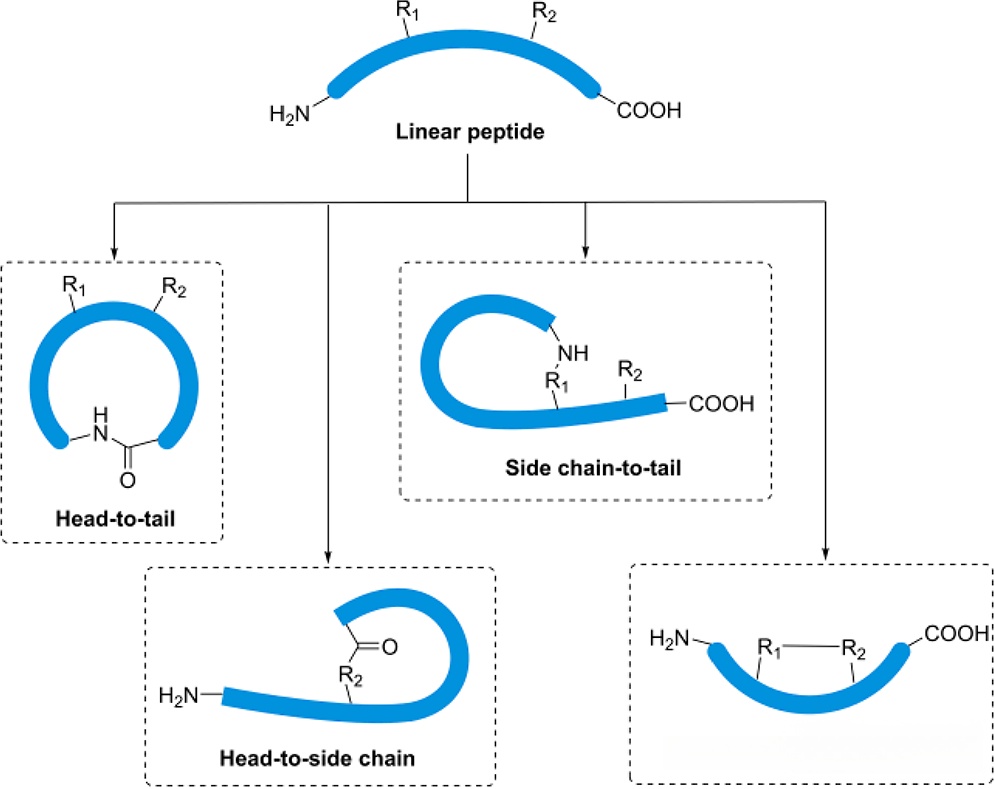
1.1 cyclic peptides as a promising therapeutic drug
as a promising therapeutic drug, cyclic peptides have received more and more attention in recent years, especially in the field of drug discovery. Compared with linear peptides, cyclic peptides have a more rigid conformation and good pharmacological properties, which are expected to be developed into therapeutic drugs. Naturally occurring cyclic peptides are present in all kingdoms of life and exhibit a variety of biological activities, including but not limited to antibacterial, anti-inflammatory, anti-tumor, anti-viral, and anti-fungal activities. Notable examples include the antibacterial agents gramicidin S and daptomycin and the immunosuppressant cyclosporine. Teixobatin and malacidin are members of a group of recently discovered cyclic peptide antibiotics with novel antibacterial mechanisms.
Cyclic peptides are more resistant to enzymatic proteolysis and therefore more metabolically stable than their linear peptide counterparts. The ring structure pre-organizes and constrains the conformation of the cyclic peptide, thereby reducing the entropy cost during receptor binding. This property increases their binding affinity and specificity for receptors and protein targets. Therefore, they are suitable for detecting and interfering with protein-protein interactions (PPIs), which are "untreatable" targets in traditional small molecule drug discovery. By suitable design, cyclic peptides can mimic protein secondary structures (e. g., α-helices and β-hairpins), which are key motifs for receptor recognition. All these favorable pharmacological features make cyclic peptides promising potential drug candidates. From 2006 to 2015, nine new cyclic peptide drugs received full approval from the US Food and Drug Administration (FDA) and the European Medicines Agency (EMA). Among them, polyethylene glycol saxapeptide was approved in 2012 and is the first brand-new cyclic peptide drug developed by rational design. As many drug candidates are in the late stages of clinical trials, it is expected that more de novo synthetic cyclic peptide drugs will enter the market in the near future.
In addition to therapeutic applications, cyclic peptides are also used in different fields such as materials science to construct nanomaterials and biochemistry as imaging agents. The wide application of cyclic peptides makes them a class of macrocycles widely studied in academia and industry. The acquisition of cyclic peptides and their analogs is the first step to fully exploit the potential of various applications of cyclic peptides. With the continuous expansion of the field of cyclic peptide drug development, it has become a new task for synthetic chemists to find the most effective and practical route of cyclic peptide synthesis. In order to achieve this goal, different methods for preparing cyclic peptides have been developed and have been continuously developed since then. In addition to traditional lactamation, ligation by chemoselective reactions to stitch the ends of linear peptide chains to form cyclic peptides is now the dominant strategy in cyclic peptide chemistry or semi-synthesis.
Post time: 2026-10-30